50 Pint vs 70 Pint Dehumidifier: Which Size Do You Actually Need?
Picking between a 50 pint and a 70 pint dehumidifier used to be simple arithmetic. Then the Department of Energy changed how these machines get rated, and the number on the box stopped meaning what it meant a few years ago. If you are comparing a new 50 pint against an older 70 pint you saw recommended somewhere, you may be comparing the exact same machine.
Quick Answer
Buy a 50 pint if you are drying a basement or living space under roughly 1,500 sq ft that feels damp rather than actively wet — under the current DOE label, that unit is the same hardware that was sold as a 70 pint before 2020. Buy a 70 pint if the space is large, chronically wet, has standing-moisture problems, or is a crawl space where you want the unit to reach its setpoint and cycle off instead of running around the clock. Dampness level drives this decision more than square footage does.
The Label Changed. The Machines Didn’t.
This is the single most important thing to understand before you shop.
Before 2020, the DOE tested dehumidifier capacity at 80°F and 60% relative humidity. The current standard tests at 65°F and 60% relative humidity — conditions much closer to what an actual basement looks like. The test procedure sits under the DOE’s appliance and equipment standards program, which is why every brand’s numbers moved at once rather than one manufacturer quietly rerating its line. Cooler air holds less moisture, so the same compressor pulls less water out of it in 24 hours, and the rated number drops by roughly 25 to 30 percent.
The result: a unit that would have been labeled 70 pint under the old standard is labeled 50 pint today. Nothing about the machine changed. Only the test conditions did.
This matters because a lot of buying advice, forum posts, and even some product listings still float around using pre-2020 numbers. If a five-year-old article told you a 70 pint was right for your basement, the current-label equivalent you should be shopping for is a 50 pint. Buying a current-label 70 pint on that advice means you are stepping up a full class from what you were told you needed — which is sometimes right, and sometimes just a bigger, louder, more expensive unit than the job calls for.
50 Pint vs 70 Pint: Spec Comparison
| Spec | 50 Pint (current DOE label) | 70 Pint (current DOE label) |
|---|---|---|
| DOE test condition | 65°F / 60% RH | 65°F / 60% RH |
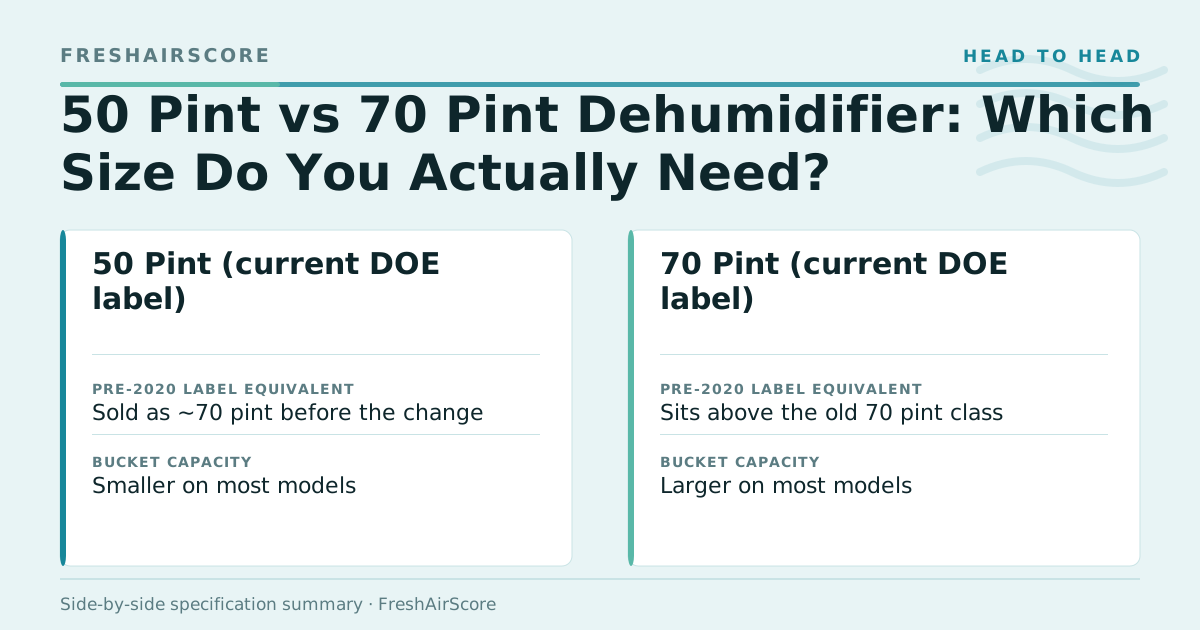
| Pre-2020 label equivalent | Sold as ~70 pint before the change | Sits above the old 70 pint class |
| Typical basement fit | Up to roughly 1,500 sq ft, moderately damp | Large basements, or any size that stays wet |
| Best-fit moisture level | Damp to very damp | Very damp to wet, standing moisture, musty odor |
| Crawl space suitability | Workable for smaller, drier crawl spaces | The more common recommendation, especially with a pump |
| Cabinet size and weight | Smaller footprint, easier to carry up stairs | Larger and heavier in most lineups |
| Bucket capacity | Smaller on most models | Larger on most models |
| Built-in condensate pump | Offered on some models | More commonly available |
| Runtime pattern in the right space | Cycles on and off | Cycles on and off |
| Runtime pattern when undersized | Runs continuously, never hits setpoint | — |
| Energy Star models available | Yes | Yes |
| Noise character | Smaller fan and compressor | Louder at equivalent fan setting |
Which Size for Your Space
Finished basements and main-floor living areas
A 50 pint is the default here. Finished spaces are usually conditioned, insulated, and only seasonally humid. You want a unit that pulls the room down to your target — 45 to 50 percent is a reasonable setpoint for most homes — then shuts off. A 70 pint in a moderately damp finished basement will hit the setpoint fast and then spend most of the day idle, which sounds efficient but mostly means you paid for capacity you never use and put a larger fan in a room where you can hear it.
If you’re not sure whether your space qualifies as a problem area at all, our guide on how to tell if you need a dehumidifier covers the symptoms worth acting on.
Unfinished basements and chronically wet spaces
This is where the 70 pint earns its keep. Unfinished basements have bare concrete walls and floors that wick moisture, poor air sealing, and often a sump pit contributing humidity directly to the room. If your basement smells musty, shows efflorescence on the block, or feels clammy in July no matter what you do, size up.
The tell is behavioral: if a correctly placed unit runs continuously and still can’t hold the setpoint, it’s undersized. Our best dehumidifier for basement roundup breaks down specific models by capacity class, and how to reduce humidity in basement covers the non-appliance fixes worth doing first — grading, gutter extensions, sealing rim joists — because a dehumidifier fighting an active water intrusion problem is a losing battle no matter how many pints it’s rated for.
Crawl spaces
Crawl spaces almost always want the larger unit, and the reason has less to do with volume than with drainage and access. A crawl space is below grade, so gravity draining to a floor drain often isn’t an option, which means you want a model with a built-in condensate pump or you’ll be crawling under the house to empty a bucket. Pump-equipped models are more common in the 70 pint class.
Crawl spaces also stay cool, which pushes compressor units toward their frost threshold. Look for auto-defrost — without it, a unit in a 55°F crawl space will ice its coil and stop removing moisture entirely. See best dehumidifier for crawl space for models built for this specific environment.
Bedrooms and small enclosed rooms
Neither. A 50 pint is overkill for a single bedroom, and both classes are loud enough to be noticeable overnight. Look at a smaller compressor unit or a Peltier model instead — best dehumidifier for bedroom covers the quiet end of the range.
What Actually Drives the Right Size
Square footage is the number everyone quotes and the least useful one on its own. Three other factors move the needle more:
Moisture level. The industry sizing convention grades spaces as moderately damp (musty smell in humid weather), very damp (damp spots on walls or floor), wet (visible seepage, damp all the time), and extremely wet (standing water, wet laundry drying in the space). Each step up effectively bumps you a capacity class for the same square footage.
Ceiling height. Sizing charts assume 8-foot ceilings. A basement with 9- or 10-foot ceilings has 12 to 25 percent more air volume than the square footage suggests.
Temperature. Compressor dehumidifiers lose efficiency as air gets colder, which is why the DOE moved its test to 65°F in the first place. A unit rated at 65°F will underperform that rating in a 55°F crawl space regardless of what the box says.
One more note on manufacturer coverage claims: when a 50 pint box advertises coverage up to 4,500 sq ft, that is the moderately-damp, 8-foot-ceiling best case. It is not a promise for a wet basement of that size. Our dehumidifier buying guide walks through drainage options, defrost, and the features that matter once you’ve settled on a capacity.
Where to Shop Each Size
- Browse 50 pint dehumidifiers for finished basements, main-floor rooms, and spaces under roughly 1,500 sq ft.
- Browse 70 pint dehumidifiers for large or chronically wet basements.
- If you’re drying a crawl space or a basement without a floor drain, filter for a dehumidifier with a built-in pump so you can run a discharge line up and out.
FAQ
Is a 70 pint dehumidifier overkill for a basement? For a moderately damp basement under about 1,500 sq ft, usually yes — a current-label 50 pint is already the equivalent of the old 70 pint recommendation. It becomes the right call when the space is large, actively wet, or the smaller unit can’t hold your setpoint.
Why is my new 50 pint dehumidifier rated lower than my old 70 pint if they look identical? Because they may genuinely be the same machine. The DOE moved the test condition from 80°F to 65°F, which cut published capacities by roughly a quarter to a third across the board. Compare the physical unit, not the label year over year.
Does a bigger dehumidifier use more electricity? Not necessarily over a full day. A correctly sized unit reaches the target humidity and cycles off; an undersized one runs nonstop and can end up drawing more total energy while performing worse. Check the integrated energy factor on the ENERGY STAR dehumidifier listings rather than assuming smaller equals cheaper to run.
Do I need a 50 or 70 pint for a 1,000 sq ft basement? A 50 pint is the starting point for a 1,000 sq ft basement that’s damp. Move to 70 if the space shows seepage, has ceilings above 8 feet, contains a sump pit, or if a 50 pint already runs continuously without reaching your setpoint.
What humidity should I set a basement dehumidifier to? Somewhere in the 45 to 50 percent range is the usual target, which sits inside the 30 to 50 percent band the EPA recommends in its brief guide to mold, moisture and your home — low enough to discourage mold and dust mites, high enough that the unit isn’t running pointlessly. What humidity level for home covers the tradeoffs by season and room.
Can a dehumidifier replace running the AC for humidity? They do different jobs. An AC removes humidity as a side effect of cooling; a dehumidifier removes it directly and adds a little heat to the room. Dehumidifier vs AC for humidity breaks down when each one is the better tool.
Conclusion
The honest version of this comparison is that most people asking “50 or 70?” are really asking a question that was already answered for them by a labeling change they never heard about. Under the current DOE standard, a 50 pint covers what a 70 pint used to, and it’s the right pick for the majority of damp — not wet — basements and living spaces.
Step up to 70 pint when the space is genuinely wet, unusually large, has high ceilings, or is a crawl space where you want extra headroom and a built-in pump. And if you’re on the fence, size by how the room behaves, not by what the sticker says: a unit that runs constantly without hitting its target is undersized, full stop.