Blueair Vs Levoit Air Purifier
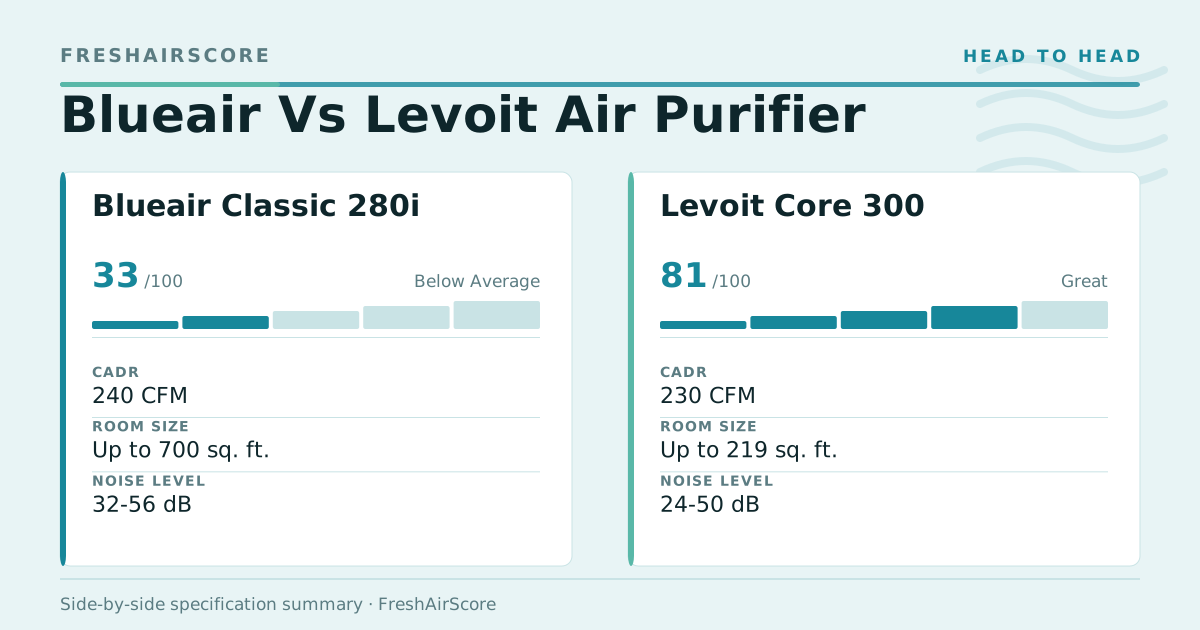
Blueair vs. Levoit Air Purifier: A Comprehensive Comparison
Quick Verdict
The Blueair handles bigger spaces with smart features but costs four times more. The Levoit delivers surprisingly solid performance for small rooms at a fraction of the price. Go Blueair if you need coverage over 400 sq ft or want app control. Otherwise, the Levoit is hard to beat.
FreshAirScore™ Ratings
Our proprietary score based on performance-per-dollar, noise levels, filter longevity, and user ratings.
Levoit Core 300 — 81/100 (Great)
████████████████░░░░
Best for: Small rooms with quiet operation
Blueair Classic 280i — 33/100 (Below Average)
███████░░░░░░░░░░░░░
Best for: Large rooms with smart features
Scores are calculated from publicly available specs including performance, noise levels, filter cost, and value. Learn about our methodology.
At a Glance
| Feature | Blueair Classic 280i | Levoit Core 300 |
|---|---|---|
| CADR | 240 CFM | 230 CFM |
| Filter Type | H13 HEPA + Activated Carbon | H13 HEPA + Activated Carbon |
| Room Size | Up to 700 sq. ft. | Up to 219 sq. ft. |
| Noise Level | 32-56 dB | 24-50 dB |
| Price Tier | Premium | Budget |
| Smart Features | Wi-Fi, app control | None |
| Weight | 13 lbs | 7.5 lbs |
| Warranty | 1 year | 2 years |
Design & Build Quality
The Blueair Classic 280i looks expensive – sleek steel construction with a minimalist vibe that actually improves most rooms. The 360-degree air intake is clever engineering, pulling air from all sides for better efficiency, and it is a design cue that runs through Blueair’s current US line-up as well.
The Levoit Core 300 takes the opposite approach: compact, white plastic cylinder that disappears into corners. It’s surprisingly well-built for the price, though it definitely feels cheaper than the Blueair. The lightweight design makes it easy to move between rooms, which I actually prefer for smaller units.
Performance
Here’s where things get interesting. The Blueair hits 240 CFM CADR and handles rooms up to 700 sq ft with its H13 HEPA and activated carbon combo, removing 99.97% of particles down to 0.1 microns, which is crucial for those concerned about Do Air Purifiers Help With Allergies.
The Levoit nearly matches it at 230 CFM CADR – that’s impressive for a budget-tier unit, and it is worth cross-checking both numbers against AHAM’s Directory of Certified Air Cleaners, since CADR is measured to a common test method rather than each brand’s own. Same H13 HEPA filtration quality, but maxes out at 219 sq ft coverage. For small apartments or bedrooms, you honestly won’t notice the difference in cleaning power.
Noise Levels
The Blueair runs 32-56 dB depending on speed. Quiet enough for most situations, but gets noticeable on high.
The Levoit wins here – drops to 24 dB in sleep mode, which is basically silent. Even at full blast (50 dB), it’s quieter than the Blueair. This one surprised me with how well it balances performance and noise.
Filter/Maintenance Costs
Blueair filters need replacing every 6 months, and a set costs roughly double the Levoit’s.
Levoit filters run on the same 6-month schedule at about half the price.
The Levoit’s lower maintenance costs add up. Over three years the filter savings alone come to more than the Levoit costs to buy.
Smart Features
The Blueair includes Wi-Fi connectivity and app control with real-time air quality monitoring. Nice to have, but honestly, most people set it and forget it anyway.
The Levoit has zero smart features – just three fan speeds and sleep mode via physical buttons. I’d skip the Blueair unless you actually plan to use the app regularly.
Price & Value
Here’s the reality: the Blueair is overpriced unless you need large room coverage or must have smart features. The build quality is better, but not four-times-the-price better. Dyson plays in the same premium territory, and our Dyson vs Levoit comparison tells a similar story.
The Levoit is borderline ridiculous value for a budget-tier unit. Same filtration quality, nearly identical CADR, quieter operation. For most people, this is the obvious choice. It holds its own against mid-range rivals too — see how it fares against Coway and Winix.
Who Should Buy Which?
-
Choose Blueair Classic 280i if:
- You need to clean rooms over 400 sq ft
- Smart features matter to you
- You prefer premium build quality and don’t mind paying for it
-
- Your room is under 300 sq ft
- You want maximum value
- Quiet operation is priority (bedrooms, offices)
FAQ
How often should I change the filters in these air purifiers? Both need new filters every 6 months.
Can I use the Blueair Classic 280i in a bedroom? Sure, but the Levoit is quieter and probably makes more sense, especially for Best Air Purifier For Bedroom. unless you have a massive bedroom.
Do these air purifiers remove odors? Yes, both have activated carbon filters for cooking smells, pet odors, and smoke. The EPA is careful to point out in its guide to air cleaners in the home that gas-phase media is consumed over time and needs replacing more often than the particle filter.
Is the Blueair Classic 280i worth the price? Only if you need the extra room coverage or really want smart features. Otherwise, the Levoit delivers 90% of the performance for 25% of the cost.
Do I need to use the app for the Blueair Classic 280i? Nope, it works fine without the app. The real question is whether you’ll actually use those features enough to justify the price difference.
Both units filter air effectively, but they serve different needs and budgets. Most people will be happier with the Levoit’s combination of performance and value.