Dyson HushJet Purifier Compact vs Levoit Core 300S: Is the Premium Desktop Worth It?
Dyson’s HushJet Purifier Compact is the brand’s first genuinely small purifier, and it lands squarely on top of the model that has owned this category for years: the Levoit Core 300S. What makes the matchup interesting is that they move almost exactly the same amount of air. Everything that separates them happens around that fact.
Quick Answer
Buy the Levoit Core 300S if you want clean air in a bedroom, office or nursery for the least money. It delivers effectively the same airflow as the Dyson, in a smaller and lighter body, at a fraction of the price tier.
Read the EPA’s guide to air cleaners in the home for the honest limits of portable filtration, then use AHAM’s Directory of Certified Air Cleaners to confirm the CADR of anything on your shortlist.
Buy the Dyson HushJet Purifier Compact HJ10 if two things are true: the purifier lives within a few feet of your head all day, and you will still own it in five years. Dyson’s case is not more clean air — it is the same clean air at a lower noise penalty, from a fully sealed machine whose main filter is rated for up to five years instead of an annual cartridge. That is a comfort-and-longevity argument, not a performance one. If your budget is the deciding factor, it is not close: take the Levoit.
Specs at a Glance
| Spec | Dyson HushJet Compact HJ10 | Levoit Core 300S |
|---|---|---|
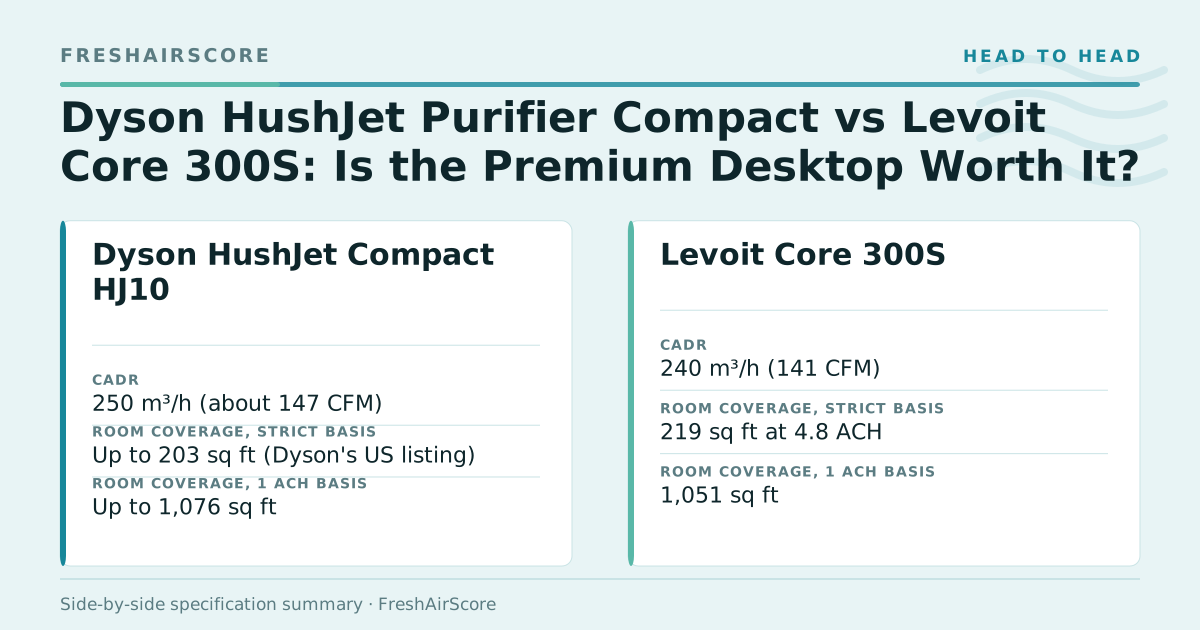
| CADR | 250 m³/h (about 147 CFM) | 240 m³/h (141 CFM) |
| Room coverage, strict basis | Up to 203 sq ft (Dyson’s US listing) | 219 sq ft at 4.8 ACH |
| Room coverage, 1 ACH basis | Up to 1,076 sq ft | 1,051 sq ft |
| Quoted noise | 24 dB in night mode; 44 dB at maximum | 22–50 dB |
| Filtration | Fully sealed electrostatic HEPA + activated carbon gas/odor filter | 3-stage: pre-filter, HEPA, activated carbon |
| Particle claim | 99.97% down to 0.3 microns | 99.97% of 0.3-micron particles |
| Main filter life | Up to 5 years (carbon stage up to 1 year) | Single cartridge, roughly 6–12 months |
| Dimensions | 230 x 230 x 470 mm (about 9.1 x 9.1 x 18.5 in) | 8.7 x 8.7 x 14.2 in |
| Weight | 3.15 kg (about 6.9 lb) | 5.95 lb |
| Rated power | Not published | 23W |
| Controls | 3 speeds on the unit, 10 in the MyDyson app | Buttons plus VeSync app |
| Sensors | PM2.5 and PM10, auto mode | AirSight Plus, auto mode |
| Voice control | Alexa, Google Assistant | Alexa, Google Assistant |
| Warranty | 2 years | 2-year limited |
| Price tier | Premium | Budget |
They Move the Same Air. Really.
This is the number that should reset your expectations: 250 m³/h against 240 m³/h. About a 4% difference in clean air delivery rate, which is inside the margin of how you place the unit in the room.
The coverage figures confirm it from both directions. On the strict basis — the one that assumes you want the room’s air genuinely turned over, not just nudged — Dyson’s US listing says 203 sq ft and Levoit says 219 sq ft. On the loose one-air-change-per-hour basis, Dyson says up to 1,076 sq ft and Levoit says 1,051 sq ft. Two brands, two marketing departments, essentially one machine class.
You will see the 1,076 sq ft figure quoted as if the HushJet is a large-room purifier. It is not. That number describes a single air change per hour, which keeps clean air clean and does nothing for a spike from cooking or an open window. Either of these units belongs in a bedroom, an office, a nursery or a dorm room — the sizes covered in our portable purifier picks and the office air purifier guide. If you want the mechanics behind the two conventions, our CADR explainer covers it.
So the Dyson is not buying you more clean air. Ask what it is buying instead.
What the Premium Actually Buys
Noise per unit of airflow. Dyson quotes 24 dB in night mode and 44 dB at maximum. Levoit quotes 22–50 dB. Levoit’s floor is marginally lower on paper; Dyson’s ceiling is meaningfully lower. That matters because a compact purifier in a small room spends real time on its upper speeds — the machine that tops out quieter is the one you leave running while you work. The HushJet’s whole design premise is the air-projection nozzle borrowed from Dyson’s jet-engine work, aimed at throwing air across the room without the broadband fan roar. Published reviews measuring at close range have logged higher figures than Dyson’s quoted maximum, as they usually do, but the ranking between the two holds.
Filter longevity. This is the most concrete difference on the sheet. The HushJet’s electrostatic main filter is rated for up to five years, with a separate carbon gas and odor filter on a roughly annual cycle. The Levoit’s single three-stage cartridge is a 6-to-12-month consumable. Over a five-year ownership window that is one main filter versus somewhere between five and ten cartridges. It does not erase the price gap, but it narrows it, and it is the strongest number in Dyson’s favor. Either way, how often you actually change a HEPA filter depends on how dirty your air is, not on the box.
Sealed construction. Dyson builds the HushJet as a fully sealed unit, so air cannot bypass the filter through the housing. On budget purifiers this is where real-world performance quietly leaks away. It is not something you can see on a spec sheet or feel in a showroom, but it is a legitimate engineering difference.
Finer control. Three speeds on the unit itself, ten through the MyDyson app, with PM2.5 and PM10 sensing. The Levoit’s VeSync app is good — schedules, auto mode, filter tracking, voice control — but its granularity is coarser.
What the Levoit Wins Outright
Size and weight. The Core 300S is 14.2 inches tall and just under 6 lb. The HushJet is 18.5 inches tall and about 6.9 lb. For something meant to sit on a desk or a nightstand, four extra inches of height is a real imposition.
Published power draw. Levoit rates the Core 300S at 23W and it is ozone-free with no ionizer. Dyson does not publish a wattage figure for the HushJet.
Price tier, by a wide margin. The Core 300S sits in the budget bracket; the HushJet sits in the premium bracket alongside the rest of Dyson’s air-treatment line. You could equip several rooms with Core 300S units for what one HushJet costs, and in most homes covering three rooms adequately beats covering one room beautifully. That math is why the Levoit keeps appearing in our value HEPA purifier shortlist.
Track record. The Core 300 line has been in homes for years. The HushJet is new in 2026, which is exciting if you like being early and irrelevant if you just want working air filtration.
Which One for Your Situation
Bedroom, and you are a light sleeper. Either works, and placement matters more than the badge — see where to place an air purifier in a bedroom. Levoit if you will run it on sleep mode all night; Dyson if you need higher speeds and still want to sleep.
Home office desk, eight hours a day, three feet from your face. This is the HushJet’s best case. You will run it at mid-to-high speed constantly, and the quieter ceiling is exactly what you are paying for.
Nursery or small kid’s room. Levoit. Cheaper, smaller, ozone-free, and if it gets knocked over you have not lost much.
You want the Dyson look but a bigger room. The HushJet is the wrong Dyson — its airflow is compact-class. Look at the larger units in the range, and read our earlier Dyson vs Levoit comparison for how that trade plays out at the top end.
You need more coverage cheaply. Step up within Levoit instead of across brands; the Core 300 vs 400 comparison shows what the next size gets you.
FAQ
Is the Dyson HushJet worth it over the Levoit Core 300S? Only for noise and filter longevity. The two have near-identical CADR, so you are not buying cleaner air — you are buying a quieter top speed, sealed construction and a five-year main filter. If the unit sits next to you all day and you keep appliances for years, that case holds. Otherwise it does not.
How many square feet does the Dyson HushJet Compact cover? Dyson’s US listing says up to 203 sq ft. The 1,076 sq ft figure quoted in other markets is based on a single air change per hour and is not comparable to the stricter room ratings.
Does the Dyson HushJet really have a five-year filter? The electrostatic main filter is rated for up to five years. The separate activated carbon gas and odor filter is on a roughly annual cycle, so you are still buying something each year — just a smaller something.
Is the Levoit Core 300S loud on the highest setting? Levoit quotes a 22–50 dB range. At the top of that range it is clearly audible, which is the practical gap between it and the Dyson’s quoted 44 dB maximum.
Do both work with an app and voice control? Yes. MyDyson and VeSync both offer scheduling, auto mode, filter tracking and Alexa or Google Assistant control. Dyson exposes ten fan speeds in-app against three on the unit.
Can either handle a living room? Not properly. Both are compact-class machines rated near 200 sq ft on the strict basis. For a living room, size up rather than buying two of the small ones.
Conclusion
The HushJet is a genuinely good compact purifier that happens to be priced against machines twice its airflow. Judged as clean-air-per-dollar it loses badly to the Core 300S, and that is the metric most buyers should use. Judged as a desk appliance you will hear every working hour for the next five years, the sealed build, the quieter ceiling and the five-year filter give it a real argument. Decide which of those two people you are before you spend — and if it is the first, the Levoit has been the right answer in this category for years and still is.