LifeStraw Home vs Brita Elite: Which Pitcher Filters More?
Both of these sit on the same shelf and look like the same product category, but they were designed to solve different problems. Brita built a filter to make municipal tap water taste better and reduce lead. LifeStraw built a filter around the assumption that the water might have things in it you can’t taste at all.
Quick Answer
Get the LifeStraw Home if PFAS, bacteria, parasites, or microplastics are on your list of concerns — it is one of the very few mainstream pitchers tested against the NSF/ANSI P473 protocol for PFOA/PFOS and the P231 protocol for microbiological reduction. Get the Brita Elite if your water is a treated municipal supply, your concerns are chlorine taste and lead, and you want faster pour speed with a single filter to keep track of. The dividing line is genuinely that clean: LifeStraw covers contaminant classes Brita does not claim to touch.
What Each Pitcher Is Actually Certified For
Certification language gets slippery in this category, so here is the precise version.
LifeStraw Home uses a two-part system: a hollow-fiber membrane microfilter plus a separate carbon and ion exchange filter. LifeStraw states the pitcher is independently lab tested to meet NSF/ANSI standards 42 (chlorine, taste and odor), 53 (lead and health contaminants), 401 (emerging contaminants such as pharmaceuticals), P231 (bacteria, parasites) and P473 (PFOA/PFOS). That P473 line is the one that matters most — it is the specific protocol written to verify PFAS reduction claims, and almost no pitcher in this price class carries it.
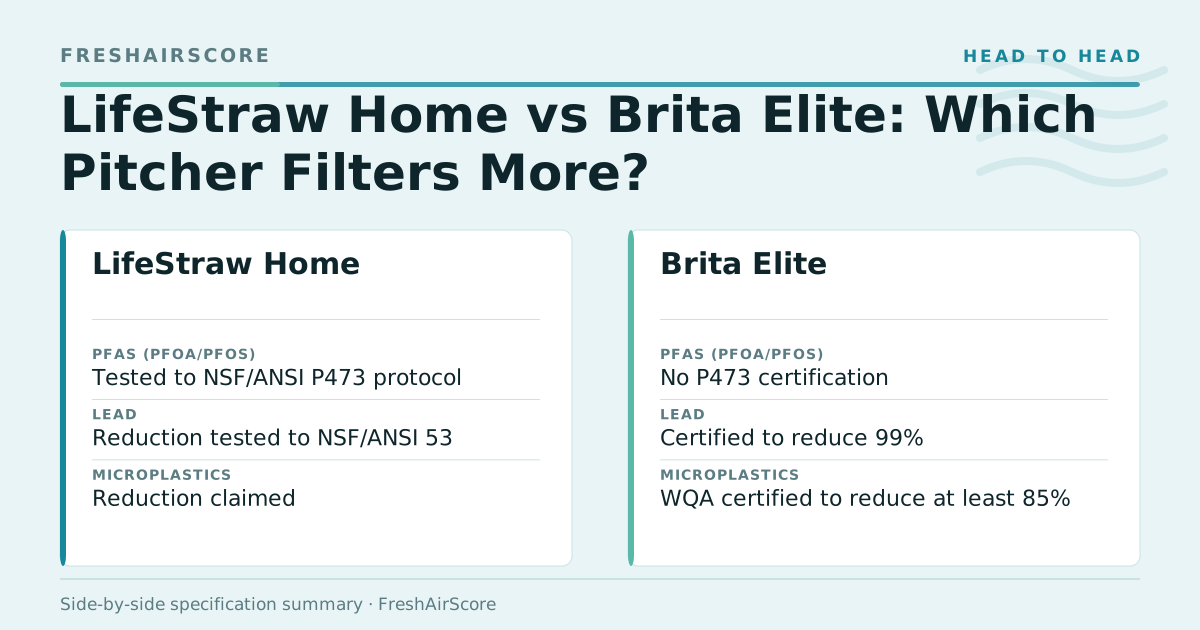
Brita Elite — the filter formerly sold as Longlast+ — is WQA certified against NSF/ANSI standards to reduce 99% of lead along with chlorine taste and odor, cadmium, mercury, asbestos, benzene, particulates, and a list Brita puts at 30+ contaminants, plus a WQA certification for reducing at least 85% of microplastics. What it does not carry is P473. Brita describes partial reduction of some PFAS compounds, but there is no P473 certification behind that, and “some PFAS compounds” is doing a lot of work in a contaminant family with thousands of members.
If PFAS is your driving concern, our best water filter for PFAS removal roundup goes deeper on what certification tiers actually mean and where pitchers stop being the right tool.
LifeStraw Home vs Brita Elite: Spec Comparison
| Spec | LifeStraw Home | Brita Elite |
|---|---|---|
| Filtration stages | Two: hollow-fiber membrane microfilter + carbon/ion exchange | One cartridge: carbon block + ion exchange |
| PFAS (PFOA/PFOS) | Tested to NSF/ANSI P473 protocol | No P473 certification |
| Bacteria and parasites | Tested to NSF/ANSI P231 (E. coli, Giardia, Cryptosporidium) | Not claimed |
| Lead | Reduction tested to NSF/ANSI 53 | Certified to reduce 99% |
| Microplastics | Reduction claimed | WQA certified to reduce at least 85% |
| Emerging contaminants (NSF 401) | Tested to protocol | Pharmaceuticals included in claim list |
| Filter life | Membrane: 264 gallons / ~1 year. Carbon: 40 gallons / ~2 months | 120 gallons / ~6 months |
| Replacement schedule | Two separate parts on two different clocks | Single filter, single clock |
| Pour speed | Slower — water passes a membrane | Faster |
| Body options | 7-cup and 10-cup, plastic or glass | Wide pitcher and dispenser lineup |
| Cross-compatibility | LifeStraw Home pitchers only | Fits most Brita pitchers and dispensers |
Which One Fits Your Water
You’re on a treated municipal supply and want better-tasting water
Brita Elite, comfortably. This is the scenario the filter was built for, and everything about the ownership experience is tuned for it: one filter, six-month replacement, fast pour, and a pitcher lineup broad enough that you can find one that fits your fridge door. The 99% lead certification also covers the most common genuine health concern in older housing stock with legacy service lines.
The pour speed difference is not a trivial detail either. A membrane filter is doing more physical work, and you feel that in the wait. If your household refills a pitcher four times a day, the faster filter wins on lived experience even if it wins on nothing else.
Your utility has reported PFAS, or you don’t trust the source
LifeStraw Home. There is no way to talk yourself into the Brita here. PFAS compounds are odorless, tasteless, and not something a standard carbon block is designed around. The P473 protocol exists precisely because manufacturers were making PFAS claims that nobody was independently verifying, and LifeStraw is one of the few pitcher makers that put its product through it.
Check your utility’s consumer confidence report first — it’s free and published annually. If PFOA or PFOS shows up, read it against the EPA’s drinking water health advisories for PFOA and PFOS to understand what the number means. A pitcher is the cheapest credible response, and this is the pitcher. If the levels are high, step up to reverse osmosis instead; see best countertop reverse osmosis for that tier.
You’re worried about bacteria, well water, or an unreliable supply
LifeStraw Home, with a caveat. The P231 microbiological protocol is a meaningful differentiator — Brita makes no bacteria or parasite claim at all, and you should not treat it as if it does. That makes LifeStraw the better fit for a private well, a cabin, an area with periodic boil-water advisories, or anyone who wants a pitcher that still does something useful when the municipal system has a bad week.
The caveat: a pitcher is a point-of-use device, not a whole-house solution, and a well with a known bacterial problem needs proper treatment at the source. Best water filter for bacteria covers the full range, and best water filter for well water addresses the whole-house side.
You want the lowest ongoing hassle
Brita Elite, on filter logistics alone. LifeStraw’s two-part design is more capable but it also means two replacement schedules running in parallel — a membrane on a roughly annual clock and a carbon stage every two months. That’s four to six carbon swaps a year plus one membrane, versus two Brita filters a year. Households that forget filter changes will get more consistent real-world performance out of the simpler system, because a lapsed filter of any kind performs like no filter at all.
Where to Buy
- LifeStraw Home water filter pitcher — 7-cup and 10-cup, plastic and glass versions.
- LifeStraw Home replacement filters — buy the carbon stage in multiples, it’s the one you’ll go through.
- Brita Elite replacement filters — the blue filter, not the white standard one.
- Brita water filter pitcher — check that the pitcher you pick accepts the Elite filter.
FAQ
Is LifeStraw Home worth it over a Brita? If PFAS, bacteria, or parasites are on your list, yes — Brita doesn’t claim those, so it isn’t really a comparison. If your only complaint is chlorine taste in city water, the LifeStraw is more filter than the job needs and you’ll pay for it in pour speed and filter changes.
Does the Brita Elite filter remove PFAS? Not verifiably. Brita describes partial reduction of some PFAS compounds, but the Elite filter does not carry NSF/ANSI P473 certification, which is the standard specifically designed to confirm PFAS reduction. You can check which claims any given model actually carries in NSF’s certified product listings. Treat the claim as unverified rather than false.
How often do I replace LifeStraw Home filters? Two schedules: the membrane microfilter is rated for 264 gallons or about a year, and the carbon and ion exchange filter for 40 gallons or roughly two months. The carbon stage is the one that will sneak up on you.
Does LifeStraw filter slower than Brita? Yes. Pushing water through a hollow-fiber membrane by gravity alone takes longer than running it through a carbon block. It’s the direct cost of the extra filtration, and it’s the most common complaint from people who switch.
Can I put a LifeStraw filter in my Brita pitcher? No. The cartridges aren’t cross-compatible, and the LifeStraw system needs both of its stages to deliver what it’s tested for. If you already own Brita pitchers and want to compare within that ecosystem, Brita vs PUR vs ZeroWater covers the alternatives that do fit.
Which pitcher is better for lead specifically? Both address lead, and Brita Elite carries the more explicit certified number at 99% reduction. If lead is your single concern and PFAS is not, Brita Elite is the more economical answer — see best water filter for lead removal for how pitchers compare against under-sink options on that contaminant.
Conclusion
This is one of the rare comparisons with a clean decision rule instead of a judgment call. LifeStraw Home is tested against protocols — P473 for PFAS, P231 for bacteria and parasites — that Brita Elite simply does not carry. If those contaminant classes are relevant to your water, the comparison is over before it starts.
If they aren’t, Brita Elite is the better daily-driver pitcher: faster to pour, one filter to remember, longer replacement interval, and a certified 99% lead reduction that handles the most common real risk in American tap water. Buy for the contaminants you actually have, not for the longest specification list — and if you’re still shopping the whole category, our best water filter pitcher rankings put both of these in context. For a different axis entirely, Berkey vs Brita compares Brita against gravity-fed systems.