Washable Filter vs Replaceable HEPA Air Purifier: Which Actually Saves Money?
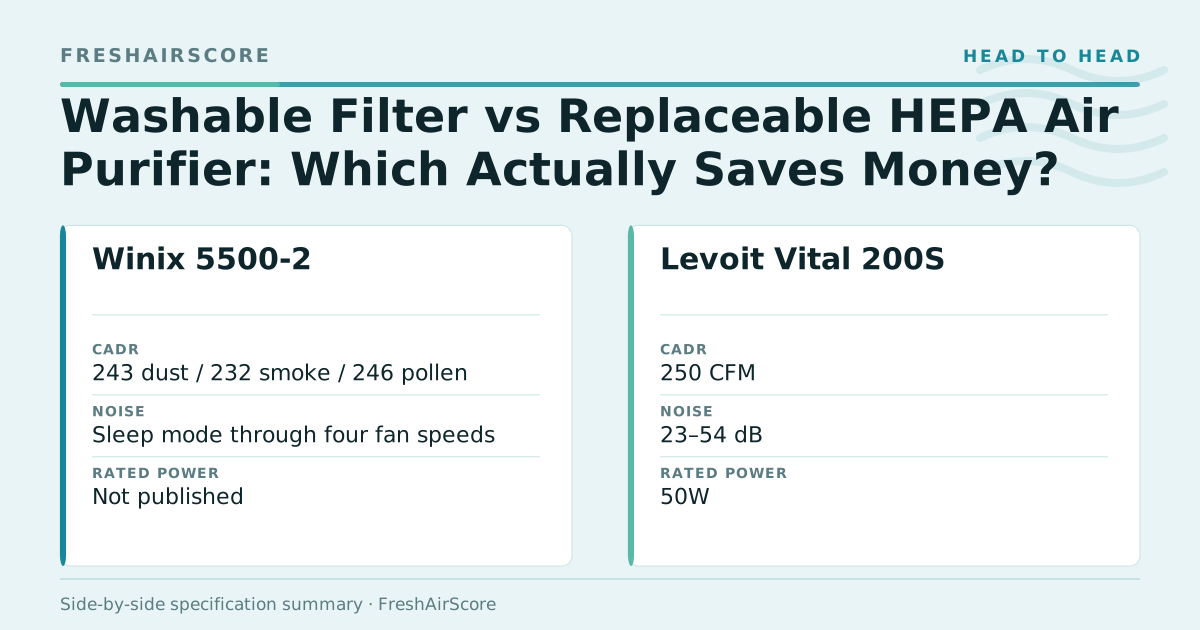
“Air purifier with washable filter” is one of the most searched phrases in this category, and it is built on a misunderstanding that manufacturers are happy to leave in place. On mainstream purifiers, the washable part is almost never the HEPA filter. Here is what is really washable, what you will still be buying every year, and where the savings actually come from.
Quick Answer
There is no mainstream purifier where you wash the HEPA filter and never buy another. On every well-known model, the washable component is the pre-filter — and sometimes an activated carbon stage — while the HEPA media itself is a replaceable consumable. Washing a standard HEPA filter damages the fiber mat and its ability to trap fine particles, which is why manufacturers say replace, not rinse.
Two independent references keep this honest: certified CADR figures in AHAM’s Directory of Certified Air Cleaners, and the EPA’s page on ozone generators sold as air cleaners for the ionizer and ozone claims that still turn up in this category.
So: buy a purifier with a detachable washable pre-filter if you have pets, heavy dust or lint, because rinsing that mesh every few weeks meaningfully extends the life of the expensive HEPA cartridge behind it. Do not buy a purifier because a listing says “washable filter” and expect to skip filter purchases — you will not. If someone offers you a purifier with a genuinely permanent washable “HEPA-type” filter and no consumables at all, treat that as a downgrade in filtration, not an upgrade in value.
What Is Washable on Two Popular Models
| Winix 5500-2 | Levoit Vital 200S | |
|---|---|---|
| Washable stage | Fine mesh pre-filter and the AOC activated carbon filter | Detachable mesh pre-filter |
| Must be replaced | True HEPA filter | 3-in-1 cartridge (HEPA + activated carbon) |
| Manufacturer replacement guidance | Change the True HEPA and the washable AOC carbon filter every 12 months | Check-filter indicator lights at roughly 12 months of use |
| Replacement part | Filter H (116130) — HEPA plus carbon sold as a set | Model-specific 3-in-1 cartridge |
| CADR | 243 dust / 232 smoke / 246 pollen | 250 CFM |
| Room rating | 360 sq ft (CADR room size) | 388 sq ft at 4.8 ACH; 1,862 sq ft at 1 ACH |
| Noise | Sleep mode through four fan speeds | 23–54 dB |
| Rated power | Not published | 50W |
| Dimensions | Upright tower, floor-standing | 15.6 x 8.5 x 19.8 in |
| Extra stage | PlasmaWave, can be switched off | None |
| Smart control | Auto mode with air quality sensor | VeSync app, Alexa, Google Assistant |
| Warranty | Manufacturer limited warranty | 2-year limited |
Look at the Winix row carefully, because it is the cleanest illustration of the whole problem. The AOC carbon filter is genuinely washable — it is a mesh holding activated carbon pellets, and rinsing it knocks the surface dust off. Winix still tells you to replace it annually along with the HEPA, and sells them together as one part. Washable does not mean permanent. It means “you can extend it between purchases.”
Why You Cannot Wash a HEPA Filter
HEPA media is a dense mat of fine fibers, and on many filters those fibers carry an electrostatic charge that pulls in particles far smaller than the physical gaps between the fibers. Running water through that mat does two things: it mats and distorts the fiber structure, and it strips the charge. What comes out the other side looks like a clean filter and performs like a worse one.
Manufacturer guidance is consistent across brands — replace HEPA filters on schedule, and only ever rinse a filter that is explicitly labeled washable or permanent. If a filter is not labeled that way, assume it is not. A washed HEPA filter also holds moisture, and a damp filter in a warm room is a mold risk you have deliberately installed in your airflow.
The one legitimate exception is the small class of purifiers sold with a permanent washable “HEPA-type” or electrostatic filter. Those are real products, but read the phrasing: “HEPA-type” is not True HEPA, and the efficiency you get after several wash cycles is not the efficiency printed on the box. For a bedroom where allergies are the point, that trade is a bad one — see our asthma-focused picks for what genuinely matters there.
Where the Real Savings Come From
Here is the part that gets lost. A washable pre-filter does save you money — just not the way the listing implies.
The pre-filter is the cheap, coarse first stage. Its job is to catch hair, lint, dander clumps and the visible dust that would otherwise load up the HEPA media. When you rinse that mesh every two to four weeks, the HEPA cartridge behind it stays cleaner, keeps its airflow, and reaches its replacement point later. That is where the money is: you are not eliminating cartridge purchases, you are stretching the interval between them.
That effect is largest in exactly the households that search for this feature — pet owners, people with carpet, anyone with heavy lint. If that is you, a detachable washable pre-filter is a genuinely worthwhile spec, and the pet allergy guide covers the rest of what to look for. If you live alone in a low-dust apartment, the pre-filter barely loads and the feature changes very little.
The second saving is subtler: a clean pre-filter keeps the fan working against less resistance, so the unit hits your target air quality at a lower speed. Lower speed means less noise and less power. It also feeds directly into how long an air purifier lasts — the fan motor is the part that eventually kills these machines, and it lives longer when it is not fighting a clogged filter.
Choosing by How Your Home Actually Loads Filters
Pets, carpet or a busy household. Prioritize a detachable washable pre-filter — one you can pull out separately, rinse under a tap and let dry. The Winix design and the Levoit Vital series both do this. What you want to avoid is a purifier where the pre-filter layer is bonded into the same cartridge as the HEPA, because then your only maintenance option is vacuuming the surface.
Smoke or cooking odors. Carbon is the stage that matters, and carbon is a consumable no matter what the listing says. Activated carbon works by adsorption: once its surface sites are saturated, rinsing does not restore them. A washable carbon mesh sheds surface dust and nothing more. Budget for annual carbon replacement and read our cooking odor guide before choosing a model.
Tight budget. The washable-filter feature is not where your savings live. Total cost is driven by the price of the main cartridge and how often the unit demands it. Compare cartridge cost and interval across the models you are considering, not the marketing bullet — that is the approach behind our budget purifier roundup.
Allergies or asthma. Stay with a True HEPA cartridge you replace on schedule. Do not buy into a permanent washable “HEPA-type” filter to avoid consumables — you are trading the exact capability you are buying the machine for.
You want the shortlist. Our best air purifiers with washable filters roundup covers the models that get the pre-filter design right, and Winix vs Levoit compares the two philosophies head to head.
FAQ
Can you wash a HEPA filter and reuse it? No, unless it is explicitly labeled washable or permanent. Water distorts the fiber mat and strips the electrostatic charge that captures the finest particles. The filter will still move air; it will not filter the same way, and a damp filter risks mold.
What does “air purifier with washable filter” actually mean? On virtually every mainstream model it means the pre-filter is washable, and on some models the activated carbon stage is too. The HEPA stage is still a replaceable part. Read the filter breakdown before assuming otherwise.
Do washable filters really save money? Indirectly, yes. Rinsing the pre-filter keeps the HEPA cartridge cleaner for longer, so you replace it less often. They do not eliminate filter purchases, and any listing implying they do is overselling.
How often should I wash the pre-filter? Every two to four weeks is the common guidance, more often with pets or heavy dust. Rinse in cool water, let it dry completely before reinstalling, and never put a damp component back into the unit. For the main cartridge, see how often to change a HEPA filter.
Is the Winix washable carbon filter permanent? No. Winix sells the HEPA and the washable AOC carbon filter together as Filter H and recommends replacing both every 12 months. Washing extends its useful life between replacements; it does not restore saturated carbon.
Are permanent washable HEPA-type purifiers worth buying? For general dust in a low-stakes room, they are defensible. For allergies, asthma, smoke or anything where fine-particle capture is the reason you are buying, they are not — the efficiency claim and the certification behind it are weaker than True HEPA. Our HEPA vs ionic comparison covers the related shortcuts to avoid.
Conclusion
The washable-versus-replaceable framing is a false choice, because every serious purifier is both: a washable pre-filter in front, a replaceable HEPA and carbon cartridge behind. Shop for the pre-filter to be detachable and easy to rinse, then compare models on the cost and interval of the main cartridge, because that is the number that determines what the machine costs you over five years. Wash the cheap part diligently, replace the expensive part on schedule, and you get both the savings the marketing promises and the filtration it quietly depends on. If you are still narrowing the field, how to choose an air purifier walks through the rest of the decision.